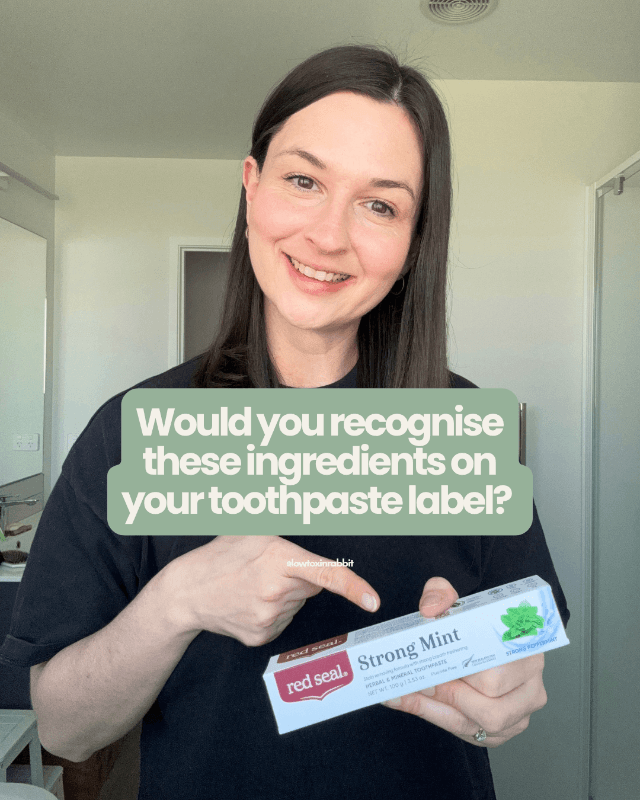
The Truth About Natural Toothpaste Ingredients

Sponsored by Red Seal. Red Seal has paid for this article and provided product and factual information. The experiences and preferences shared are my own.
We put a lot of thought into what goes in and on our bodies, but how often do you pick up a tube of toothpaste and examine the ingredients the way you do on the back of a food packet? You use it twice a day, every day, over 700 times a year, and many of us have probably never once turned the box over. I know I didn’t before I started my health journey.
The toothpaste aisle offers more variety than ever but navigating all the options can feel overwhelming. Natural. Naturally derived. Plant-based. Clean. Botanical. Herbal. Mineral. Some carry certification logos and some don't. Some are four dollars and some are fourteen, and there is not a lot of information on the front of the pack to tell you what the difference is!
To be transparent from the outset: we use Red Seal, usually the hydroxyapatite one or one of their other fluoride-free options. They use mineral and herbal ingredients we're happy with at a great price, and the NATRUE certification means their formulations have been independently checked. In this article, we'll look at what some of these terms mean, what ingredient lists can tell us, and what different certification logos are designed to verify.
What "natural" actually means on a toothpaste label
In New Zealand, there is no single legal definition that applies to every use of the word “natural” on a personal care product. However, natural claims must still be accurate, substantiated and not misleading. Different brands may use the term in different ways, which can make it difficult for consumers to understand exactly what sits behind a natural claim.
So, the word "natural" doesn't tell you much on its own, which is why so many of us come away from the aisle feeling like we're guessing - is this actually natural? A good place to start is the ingredient list.
How to read a toothpaste ingredient list
Ingredient lists look intimidating, but they follow rules. Three things worth knowing:
Ingredients are generally listed according to applicable ingredient labelling requirements, with ingredients present at higher levels often appearing earlier in the list. In New Zealand, that ordering applies to ingredients at 1% or more. Anything under 1% can go in any order.
The names are INCI names, not plain English names. INCI stands for International Nomenclature of Cosmetic Ingredients, a standardised system used across most major markets, so the same ingredient reads the same way on a tube in Auckland, Osaka, or Berlin. It's why peppermint oil shows up as Mentha Piperita (Peppermint) Oil. That Latin-looking name isn't a red flag; it's the plant's Binomial name.
An ingredient's name doesn't necessarily tell you whether it comes from a natural or synthetic source. Water is Aqua. Baking soda is Sodium Bicarbonate. Sea salt is, thankfully, Sea Salt.
Here's a translation of common ingredients found in toothpaste:
On the label | What it actually is |
Glycerin | A humectant that stops the paste drying out |
Calcium Carbonate | A mineral used as a gentle abrasive |
Hydrated Silica | A mineral abrasive derived from silica |
Hydroxyapatite | A calcium phosphate mineral used in some toothpaste formulations |
Sodium Fluoride / Sodium Monofluorophosphate | Mineral salts added to help prevent decay |
Sodium Bicarbonate | Baking soda |
Xylitol | A sugar alcohol used as a sweetener |
Stevioside | The sweet compound from the stevia plant |
Bentonite | A clay mineral |
Xanthan Gum | A thickener produced by fermentation |
Sodium Cocoyl Glutamate | A mild foaming agent derived from coconut and an amino acid |
Sodium Lauryl Sulphate (SLS) | A foaming agent commonly used in toothpaste. |
Lauryl Glucoside | A mild foaming agent made from coconut or palm oil and plant sugar |
Aroma / Flavour | The flavour system, which may be natural or synthetic |
You don't need to memorise this list. It's just important to know that an ingredient list is decodable, and a two-minute search on an unfamiliar name will tell you what it is and where it comes from. This is why ingredient transparency is important. It helps consumers understand the ingredients used in a formulation.
One thing worth checking separately: whether the full ingredient list is on the brand's website, not just the box. It's a straightforward way to get an idea of how transparent a brand is being across all its channels.
What the certifications actually verify
This is where independent certification becomes useful. Rather than relying on a brand's own description of its products, third-party certification bodies assess formulations against defined criteria. The certification either applies or it doesn't.
What NATRUE certification requires
NATRUE is a certification you may come across on natural products, including toothpaste. But what does that logo actually tell you?
It's a Brussels-based international non-profit association, founded in 2007 to promote and protect natural and organic cosmetics. Here's the part worth knowing: NATRUE writes the standard but doesn't do the certifying itself. That's carried out by separately accredited certifiers, which helps provide independent verification. Every certified product then goes into a public database that you can search yourself, which is very much the point. It currently lists around 5,500 finished products and another 4,800 or so certified raw materials, because the standard covers ingredients as well as the finished tube. Its stated principles include a focus on ingredient transparency and independent certification and a ban on animal testing.
What makes it useful is that it defines its terms. NATRUE sorts every ingredient into one of three tiers:
Natural substances. Obtained directly from nature. Plant extracts, minerals and so on.
Derived natural substances. Created from natural substances using approved chemical or biotechnological processes and only allowed where a natural substance can't do the job.
Nature-identical substances. Compounds that exist in nature but are reproduced synthetically. Permitted only from a closed list, and only where the natural version can't reasonably be obtained.
Then it sets thresholds for how much of a formulation must be natural and how much may be derived natural. There are thirteen categories, and oral care has its own. For toothpaste, no more than 70% of the formulation can be derived natural substances, and at least 2% must be natural substances. That 2% may sound low, but toothpaste is mostly water and mineral abrasives.
A lot is also not permitted: no silicones, parabens, mineral oils, microplastics or synthetic fragrances. That follows from the tiers themselves.
For a consumer trying to understand whether a "natural" claim has any substance behind it, a NATRUE mark is a practical shortcut. It means someone other than the brand has checked.
What's the difference between vegan and cruelty free?
When we think of vegan, we instantly assume cruelty free, but one does not guarantee the other. So, what does each one actually mean?
· Vegan certification confirms no animal-derived ingredients. In oral care that usually means beeswax, propolis or animal-derived glycerin. The Vegan Society, founded in 1944, launched its Vegan Trademark in 1990. Worth noting: because propolis is a bee-derived ingredient, products containing propolis generally won't meet vegan certification requirements.
· Cruelty free confirms no animal testing. They are both completely separate, and the two don't imply each other at all. A product can be vegan and tested on animals, or cruelty free and contain beeswax.
Does it matter where your toothpaste is made?
One thing that you might not know is that the country of origin isn't required on cosmetics in New Zealand, and even the Buy NZ Made kiwi is a voluntary trademark rather than a legal mark. So, when a brand tells you where a product is made, whether with the kiwi or a plain "Made in New Zealand" statement, it's sharing information that can matter to people who prefer to buy local.
Where something is made can tell you a lot more than you think, such as which regulatory framework the product was made under. If supporting local manufacturing matters to you, and it definitely does to me, it's the only way to know that you are.
What certifications don't cover
Certifications matter, but a tube is only any use if the people in your house will actually use it. A few things I've learned the hard way:
Flavour can play a big role in whether people continue using a toothpaste. Naturally formulated pastes often lean on essential oils, so mint can taste more herbal and less sweet than expected. Some ranges include non-mint options like lemon, aniseed and fruit flavours for the kids, which is a lifesaver if someone in your house has decided they hate mint.
The amount of foam a toothpaste produces doesn't necessarily indicate how effective it is. Give a new tube a week before you write it off.
Check what the kids' version actually is. Children's toothpaste is often a different formulation, not just a different flavour, and the certifications on the adult product don't automatically carry across.
A toothpaste we recommend
Red Seal NATRUE Certified Natural Toothpaste
Red Seal is a New Zealand brand that has been making toothpaste locally for decades. Their toothpaste range is NATRUE certified natural, which means the formulations have been independently assessed against NATRUE's criteria for natural ingredient origin and processing, rather than simply labelled as natural by the manufacturer. The range is also vegan certified (excluding Propolis) and cruelty free.
That it's made here is a bonus for us, as we want to support local manufacturers where we can. Red Seal toothpastes are also SLS free and paraben free, with no artificial flavours or synthetic colours. They've made some small but important changes recently, and the mineral and herbal ingredients they use are ones we're happy with as a family. We particularly love that they now have a hydroxyapatite toothpaste option, at a price that makes it accessible.
Red Seal publishes ingredient information and answers frequently asked questions about their formulations on their website, which made it easy for me to dig deeper into the ingredients and certifications.
If you're working through all of this at the supermarket, Red Seal's natural range carries the certifications discussed above without a trip to a specialist health store, and it's widely stocked in New Zealand supermarkets and pharmacies.
You can browse their full toothpaste range at redseal.global, and their NATRUE certification information is available at redseal.global/nz/natrue-certified-natural-toothpaste.
Practical summary
· There is no specific legal definition of 'natural' for cosmetics in New Zealand, and the meaning of the term can vary between markets and certification scheme.
NATRUE certification requires a defined proportion of natural-origin ingredients and prohibits specific ingredients such as mineral oils, silicones, parabens and synthetic fragrances. It is independently audited.
Vegan and cruelty-free certifications cover different things. Look for logos from recognised certifying bodies rather than text claims alone.
Ingredients are listed in descending order of quantity. The first five or six tell you what the product actually is. INCI names are standardised and searchable.
Check whether the full ingredient list is on the brand's website as well as the box. It's a simple transparency test.
Red Seal's toothpaste range is NATRUE certified, vegan certified, cruelty-free, and made in New Zealand, with both fluoride and fluoride-free options available.
References
1. NATRUE International Association. (2023). The NATRUE Standard for Natural and Organic Cosmetics. https://www.natrue.org/our-standard/
2. Red Seal New Zealand. https://www.redseal.global/nz/

People who viewed this also viewed
Clean Protein Powder in NZ and Australia: I Asked the Brands for Their Test Results

Non-Nano vs Nano Hydroxyapatite Toothpaste: Why the Particle Size Actually Matters

Top Low Tox Nappy Options
The Best Non-Toxic Baby and Kids Dinnerware in NZ and AU

Are Plastic Lunch Boxes Safe? A Guide to the Best Low-Tox Lunch Boxes for Kids