
What's Actually in a Lollipop (And What We Swap Them For)
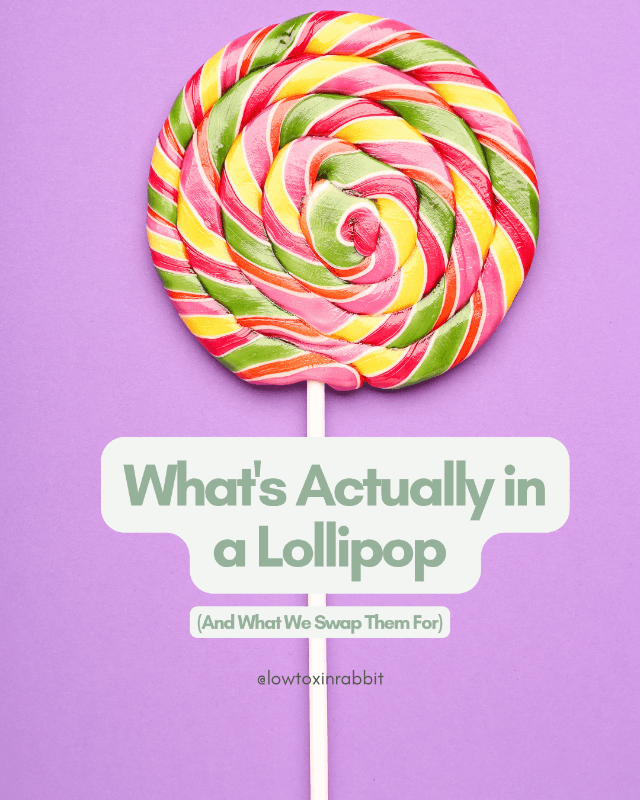
End of term at school and someone hands your kid a lollipop. It's a kind gesture, and your child thinks it great. But if you've ever looked at the ingredients on a standard lollipop wrapper, you'll know exactly why some parents wince a little while smiling politely.
We've been there more times than I can count. weekend sports days, swimming lessons, school activities the list goes on. The lolly bag comes out and the kids go absolutely feral about an hour later. It's not the sugar alone doing that. It's what else is hiding in it aka synthetic colours.
What's Actually in a Conventional Lollipop
Here are the ingredients from two standard lollipops you'd pick up from a typical lolly shop or supermarket bin.
Lollipop one: Sugar, glucose syrup, food acid (citric acid), flavours, colours (102, 110, 124, 133).
Lollipop two: Sugar, glucose syrup, water, citric acid, flavours, colours (102, 122, 129, 133, 171).
-1774948580992.png)
The ingredient lists are short, which can make them look harmless. The major problem is those colour numbers at the end.
What Those Colour Numbers Actually Are
In Australia and New Zealand, food additives are listed by their code number rather than their full name, which makes it easy to miss what you're actually giving your child.
102 is Tartrazine, a synthetic yellow dye derived from coal tar. A 2007 study published in The Lancet found that a mixture of certain artificial food colours including Tartrazine significantly increased hyperactive behaviour in children. The UK Food Standards Agency took that research seriously enough to recommend that manufacturers voluntarily remove six of these dyes, including Tartrazine, from food products for children. The EU now requires a warning label on any food containing these dyes stating that the product "may have an adverse effect on activity and attention in children".
110 is Sunset Yellow, another synthetic azo dye. It's one of the six colours included in the Southampton study mentioned above and carries the same EU warning requirement. Some studies have also linked it to allergic reactions in children sensitive to aspirin.
122 is Azorubine, also known as Carmoisine. Also an azo dye, also part of the Southampton six, and also subject to the EU warning label requirement.
124 is Ponceau 4R, a red synthetic dye. Same family, same concerns, same EU warning.
129 is Allura Red, yet another azo dye. Research published in Nature Reviews Neuroscience in 2022 raised fresh concerns about Allura Red specifically, linking it to inflammation of the gut and potentially affecting serotonin production in the gut lining, which plays a role in brain function and mood regulation.
133 is Brilliant Blue. This one appears in both lollipops above. It's a synthetic dye with less research behind it than the azo dyes, but it's still a petroleum-derived synthetic colour that has no nutritional value whatsoever.
171 is Titanium Dioxide, used to make the white colour in some lollies. In 2021 the European Food Safety Authority concluded it could no longer be considered safe as a food additive, citing concerns about potential genotoxicity, meaning it may cause DNA damage. France banned it in food products in 2020. Australia and New Zealand have not followed.
So in those two small lollipops you've got up to five synthetic azo dyes that have been formally linked to hyperactivity and attention issues in children, and a whitening agent that Europe has now prohibited in food.
The Hyperactivity Connection
Parents often put the post-party chaos down to a sugar high, but the research suggests synthetic dyes play a more significant role than sugar in driving hyperactive behaviour. The 2007 McCann et al. study in The Lancet tested children aged three and eight to nine years old, and found measurable increases in hyperactivity from a mixture of artificial colours and the preservative sodium benzoate at levels typically found in food and drinks. The effect was observed in the general population, not just children already diagnosed with ADHD.
The Food Standards Australia New Zealand (FSANZ) body has reviewed the evidence and maintains the colours are safe at permitted levels. However, their assessments don't account for the cumulative load across a whole day of eating processed food, multiple lollies, brightly coloured drinks, and packaged snacks. In practice, end of term often means a child gets far more than a single lollipop's worth of synthetic dye in one afternoon.
What We Swap Them For
We keep a bag of YumEarth Organic Pops in the pantry specifically for situations like this. End of term is predictable enough that it's easy to plan ahead. When the kind gesture lollipop comes out, we swap them out.
The YumEarth Organic Pops not only avoid nasties, they also have a good dose of Vitamin C which is actually good for them. The rest of the ingredient list looks like this: Organic cane sugar, organic brown rice syrup, organic natural flavours, citric acid, ascorbic acid, coloured with organic concentrate (carrot, apple. blackcurrant, radish), organic turmeric extract (colour).
-1774951292883.png)
That's it. The colours come from actual fruit and vegetable concentrates rather than petroleum-derived dyes. The flavours are organic and natural rather than synthetic. There's ascorbic acid, which is vitamin C, used as an antioxidant. Nothing in that list has a number code because nothing in that list is a synthetic chemical additive.
The kids also actually like them and still feel like they are getting a treat. They taste like a real lollipop, they come on a proper stick, and they're every bit as satisfying as the conventional version for a child who just wants something sweet after swimming.
*Affiliate Link - Use DCV0116 with Iherb
Are Lollipops Safe for Toddlers?
This is worth addressing separately because it comes up a lot. From a choking standpoint, lollipops generally aren't recommended for children under three because of the stick and the hard candy itself. Even with organic lollipops, this applies. For toddlers who want a sweet treat, something softer and without a stick is a safer format.
From an ingredient standpoint, toddlers are actually more vulnerable to synthetic dye exposure than older children because they weigh less and eat proportionally more for their body weight. If you're going to offer a lollipop to a child who is old enough to eat one safely, it makes considerably more sense to choose one coloured with fruit and vegetable concentrates than one containing Tartrazine and Sunset Yellow.
Reading the Label at the Lolly Shop
If you're buying from a lolly shop or picking up a treat for a birthday bag, the colour codes to look out for and avoid are 102, 107, 110, 122, 123, 124, 129, and 133. These are the synthetic azo and coal tar dyes with the strongest evidence for adverse effects in children. If you see 171, that's the titanium dioxide worth avoiding too.
Look instead for products that list "coloured with fruit and vegetable juice" or name specific plant sources like beetroot, spirulina, or turmeric. These are entirely different substances and there is no comparable body of evidence linking them to behavioural effects in children.
The swap doesn't require your kids to miss out. It just requires you to have the better version on hand before the lolly bag appears.
A Quick Summary
Standard lollipops commonly contain synthetic dyes 102, 110, 122, 124, 129, and 133, which are azo dyes linked to hyperactivity in children by peer-reviewed research including a 2007 Lancet study.
Colour 171 (titanium dioxide) is also found in some lollies and has been banned from food in the EU following safety concerns.
The EU requires warning labels on foods containing these dyes. Australia and New Zealand do not.
YumEarth Organic Pops use organic fruit and vegetable concentrates for colour and contain no synthetic dyes or artificial flavours.
For toddlers under three, all lollipops on a stick carry a choking risk regardless of ingredients.
Keeping a better option on hand for end of term events means your kids don't miss out and you don't have to be the parent who says no.
References
McCann, D. et al. (2007). Food additives and hyperactive behaviour in 3-year-old and 8/9-year-old children in the community: a randomised, double-blinded, placebo-controlled trial. The Lancet, 370(9598), 1560–1567. https://doi.org/10.1016/S0140-6736(07)61306-3
European Food Safety Authority (2021). Re-evaluation of titanium dioxide (E 171) as a food additive. EFSA Journal, 19(5), e06585. https://doi.org/10.2903/j.efsa.2021.6585
Bhatt, D.L. et al., citing Rao, M. et al. (2022). Synthetic food dye Allura Red and gut inflammation. Nature Communications. Referenced in subsequent review: Karhu, E. et al. (2023). Gut microbiota and food dyes. https://www.nature.com/articles/s41467-022-35309-y
UK Food Standards Agency (2008). Food colour and hyperactivity. https://www.food.gov.uk/science/additives/colours/food-colours-and-hyperactivity
Food Standards Australia New Zealand (2023). Artificial food colours and hyperactivity. https://www.foodstandards.gov.au/consumer/additives/foodcolour
Frequently Asked Questions
What are the safest lollipops for kids?
Lollipops coloured with organic fruit and vegetable concentrates rather than synthetic dye codes are the safer option. YumEarth Organic Pops are a widely available example. Look for labels that name the colour source, such as beetroot, turmeric, or spirulina, rather than listing a number code like 102 or 110.
Which food colour numbers should I avoid in kids' lollies?
The main ones to avoid are 102 (Tartrazine), 110 (Sunset Yellow), 122 (Azorubine), 124 (Ponceau 4R), 129 (Allura Red), and 133 (Brilliant Blue). These are the synthetic dyes most strongly associated with hyperactivity and attention issues in children. Also look out for 171 (Titanium Dioxide), which has been banned in food in the EU.
Are lollipops safe for toddlers?
From a choking perspective, lollipops on a stick are generally not recommended for children under three. From an ingredient perspective, toddlers are more susceptible to synthetic dye exposure due to their smaller body weight, so if you do give a lollipop to an older toddler who can eat one safely, choosing one coloured with fruit and vegetable concentrates is a much better option than one containing synthetic azo dyes.
Do artificial food colours really cause hyperactivity?
The most significant evidence comes from a 2007 study published in The Lancet, which found that a mixture of artificial food colours significantly increased hyperactive behaviour in children aged three and eight to nine years old. The effect was seen across the general population, not just children with ADHD. The EU responded by requiring warning labels on foods containing these dyes. Australia and New Zealand have not introduced the same requirement.
What is titanium dioxide (171) doing in lollies?
Titanium dioxide is used as a whitening agent in some lollies and confectionery. In 2021 the European Food Safety Authority concluded it could no longer be considered safe as a food additive, citing potential concerns about DNA damage. France banned it from food in 2020, and the EU followed. It is still permitted in food in Australia and New Zealand.
How do I make sure my child doesn't miss out when other kids are eating conventional lollies?
Keep a better alternative on hand for predictable occasions like end of term, birthday parties, and sports days. YumEarth Organic Pops are a practical swap because they look and taste like a conventional lollipop. A quiet swap before the lolly bag goes around means your child gets a treat without the synthetic dyes, and without feeling singled out.

.png&w=828&q=75&dpl=dpl_AJeU9jhf1b3cPtatKVTVssFYN6Hp)
.png&w=828&q=75&dpl=dpl_AJeU9jhf1b3cPtatKVTVssFYN6Hp)